
Artificial intelligence is entering hospitals through clinical tools, operational systems, documentation workflows, decision-support environments, and vendor platforms faster than most leadership teams realize.
Without governance structures, organizations may face hidden exposure involving patient safety, policy misalignment, vendor accountability, regulatory risk, and inconsistent oversight.
PalanQuant AI Solutions provides governance-first AI advisory designed specifically for healthcare systems.

Confidential executive briefing for hospitals and health systems seeking a structured approach to responsible AI adoption.
Healthcare organizations are under increasing pressure to explore artificial intelligence for operational efficiency, clinical workflow support, documentation, patient engagement, and vendor-enabled innovation.
The challenge is that adoption often begins in fragmented ways across departments, platforms, and vendor relationships before leadership has a complete line of sight.
This creates potential exposure related to:
Leading organizations are now recognizing that innovation without governance creates avoidable exposure.
PalanQuant AI Solutions helps healthcare leadership establish structured governance before uncontrolled AI adoption becomes an enterprise liability.
PalanQuant AI Solutions uses a structured exposure assessment to help healthcare leadership identify where artificial intelligence may already be active across the organization, whether formally approved, vendor-enabled, department-led, or informally adopted.
The output includes an executive-facing AI Exposure Heatmap that highlights areas of elevated visibility need, oversight gaps, and governance risk.
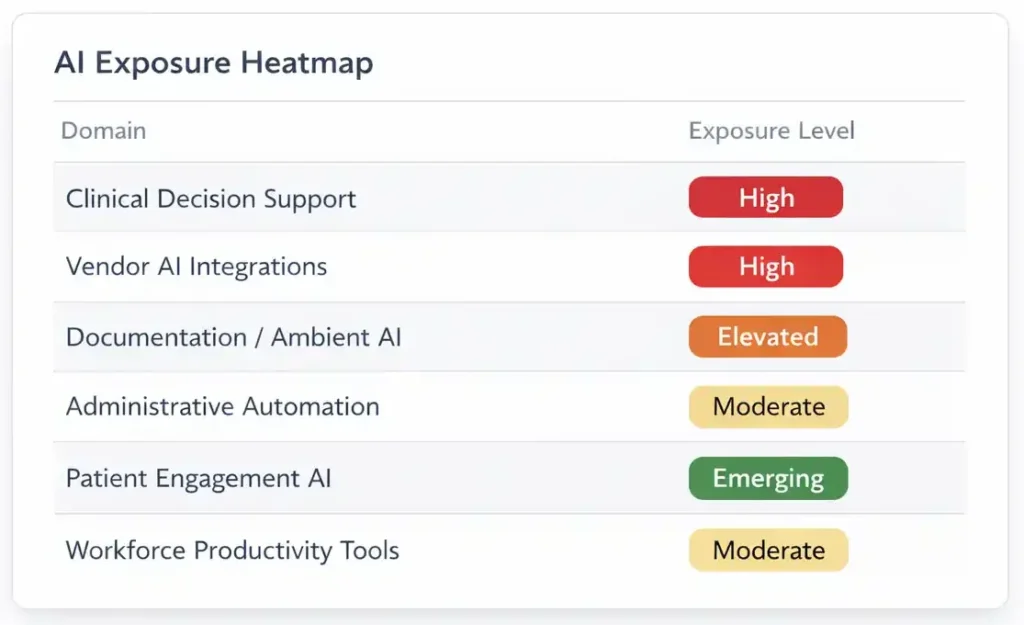

The PQ Governance Leadership Briefing is a focused executive discussion designed to help healthcare leadership understand their organization’s current or potential AI exposure and the governance structures required to manage it responsibly.
The session is structured to clarify where organizations may be vulnerable, what leadership should be asking, and how governance can be designed to support both innovation and protection.
During the briefing, leadership teams explore:
where AI typically enters hospitals without full executive visibility
the governance gaps most commonly found across healthcare environments
the operational and regulatory implications of uncontrolled AI adoption
what responsible oversight should include before scaling AI use
the first governance actions leadership can take to reduce exposure
Relevant for executive sponsors overseeing AI strategy, vendor governance, digital innovation, or enterprise risk.
Designed for executive, operational, and technical audiences, each engagement focuses on the real governance structures, risk controls, and leadership strategies organizations need before expanding AI across systems and facilities.
Clearer visibility into where AI may already be entering the organization.
A practical view of the structures needed for safe, responsible AI oversight.
Guidance on how to support innovation without losing executive control.
A stronger lens for evaluating AI-enabled vendors and third-party risk.
PalanQuant AI Solutions is not built around generic AI enthusiasm or unstructured advisory. The firm’s approach is governance-first.
That means AI adoption is evaluated through the lens of:
PalanQuant AI Solutions is a governance-focused AI advisory firm supporting healthcare organizations as they adopt artificial intelligence responsibly.
The firm specializes in governance structures, policy direction, controlled implementation frameworks, executive oversight models, and continuous risk surveillance.
The objective is simple: enable innovation while protecting patients, clinicians, operations, and institutional trust.